HW/SW Lifecycle
Forward’s Network Query Engine (NQE) includes structured End-of-Life (EoL) and End-of-Support (EoS) information
for both operating systems and hardware components across supported network platforms. This data is surfaced through the
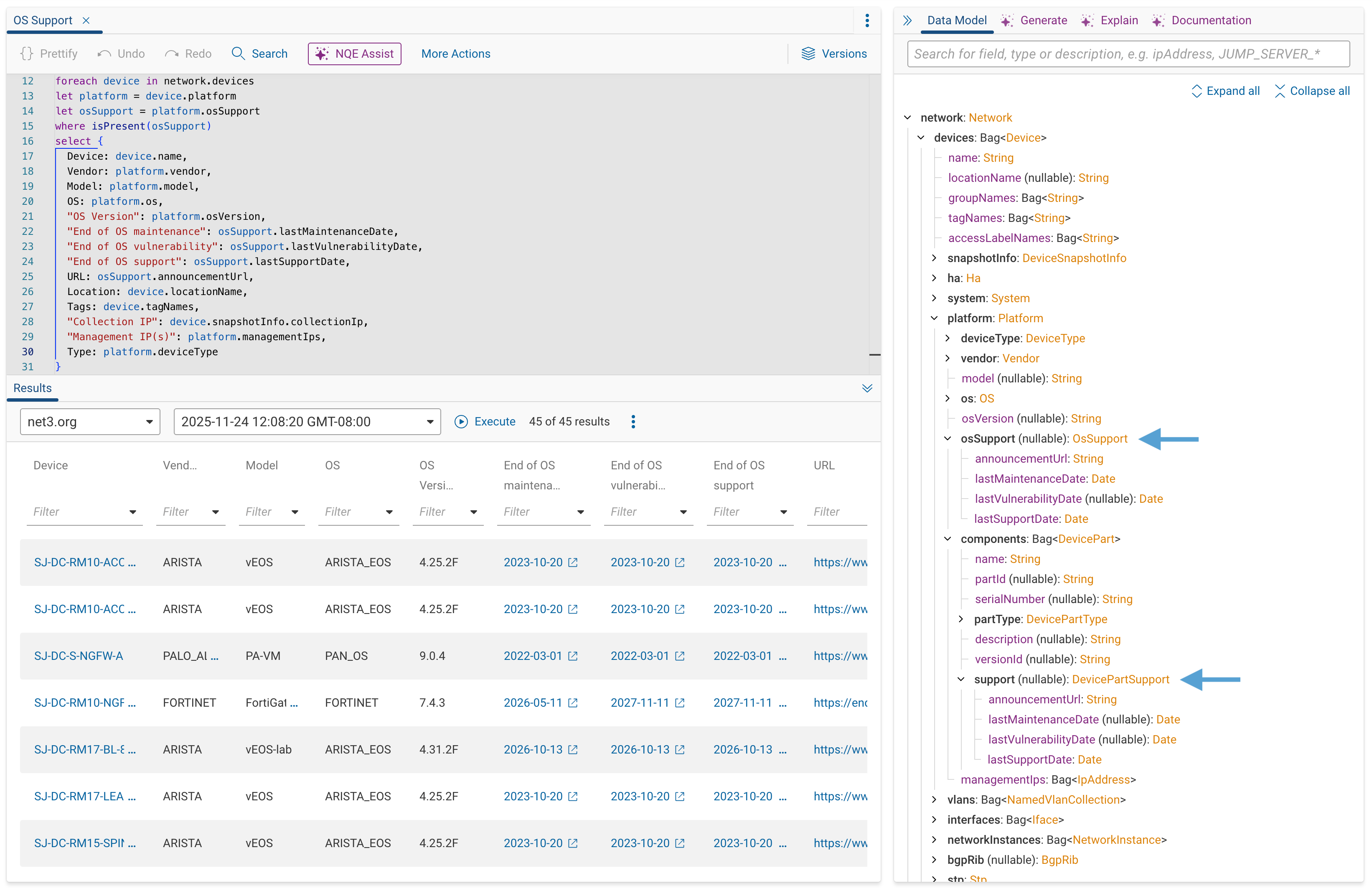
NQE data model under each device’s platform.osSupport and platform.components.support fields.
This page provides an overview of the purpose, behavior, and scope of this EoL/EoS data.
Why This Matters
Tracking lifecycle milestones across diverse vendor platforms is typically manual and error-prone. Embedding lifecycle metadata directly into the network model ensures that Forward can:
- Identify devices that are running software or hardware versions that are unsupported or approaching end-of-support.
- Provide consistent lifecycle information across vendors
- Support automated, snapshot-aware analysis
- Eliminate the need for operators to manually maintain or reference vendor lifecycle sheets
What the NQE Data Model Provides
Operating System Lifecycle (platform.osSupport)
For each recognized OS family, the model includes:
network > devices > platform: Normalized OS identifiersnetwork > devices > platform > osVersion: Version ranges coverednetwork > devices > platform > osSupport > lastMaintenanceDate: End of maintenancenetwork > devices > platform > osSupport > lastVulnerabilityDate: End of vulnerability supportnetwork > devices > platform > osSupport > lastSupportDate: End of complete supportnetwork > devices > platform > osSupport > announcementUrl: References to vendor lifecycle documentation
Devices whose OS does not match any entry in the data model will simply not have lifecycle data returned.
Hardware Component Lifecycle (platform.components.support)
For hardware, the model covers Part-level lifecycle milestones (if published by vendor):
network > devices > platform > components > partId: part identifiersnetwork > devices > platform > components > support > lastMaintenanceDate: End of maintenancenetwork > devices > platform > components > support > lastVulnerabilityDate: End of vulnerability supportnetwork > devices > platform > components > support > lastSupportDate: End of complete supportnetwork > devices > platform > components > partType: Structured attributes such as part type, version, serial-number applicability, etc.network > devices > platform > components > support > announcementUrl:Vendor reference URLs
Hardware components not defined in the data model will not be associated with EoL/EoS information.
Integration with Inventory+ (NQE)
Inventory+ includes prebuilt queries (“OS Support” and “Hardware Support”) that directly consume this same lifecycle data from NQE. These queries allow users to view EoL/EoS information immediately—no code or custom queries required—using the data defined in the NQE model. Only platforms included in the lifecycle dataset appear in these results; devices running unsupported OSes or hardware simply do not show up in the OS/Hardware Support views. The library queries provide a convenient, UI-driven way to explore lifecycle status across all supported devices in a snapshot.
Supported Platforms (Software and Hardware)
The complete list of platforms for which EoL/EoS lifecycle data is available is maintained internally and may grow over time.
OS lifecycle support coverage
| Vendor | OS |
|---|---|
| Arista | EOS |
| Checkpoint | |
| Cisco | IOS |
| Cisco | IOS-XE |
| Cisco | IOS-XR |
| Cisco | NXOS |
| F5 | |
| Fortinet | |
| Juniper | JUNOS |
| Palo Alto | CLOUDGENIX |
| Palo Alto Networks | PAN-OS |
Hardware lifecycle support coverage
| Vendor |
|---|
| CHECKPOINT |
| CISCO |
| F5 |
| FORTINET |
| PALO_ALTO_NETWORKS |
Summary
The NQE EoL/EoS data model provides a normalized, vendor-independent foundation for assessing lifecycle status across both software and hardware. It enables automated lifecycle evaluation in NQE queries and drives the Inventory+ OS/Hardware Support views, helping operators proactively manage lifecycle risk without external tooling.